To buy at Copart, you need a free Basic membership, a refundable deposit, and a clear understanding of total costs before you bid. The winning bid is only part of what you'll pay, buyer fees, virtual bid fees, and gate release add $400-$600+ to most transactions.
Copart is one of the largest salvage vehicle auctions in North America, moving hundreds of thousands of vehicles per year. Getting started isn't hard, but first-time buyers who skip the cost research regularly end up overpaying by hundreds of dollars on their first purchase.
This guide walks you through every step, in order, so you don't have to learn any of it the expensive way.
Step 1: Get Your Membership Set Up
Every buyer needs a Copart account before placing a bid. Registration is free at copart.com and takes about 10 minutes.
You'll provide your name, address, and contact information. Individual buyers register as a Basic member by default. If you're a licensed dealer, you can register under a dealer account, which gives access to dealer-only sales events.
After registration, Copart typically requires a refundable security deposit before you can bid. For individual buyers, this is usually $400. The deposit is held while your account is active and applied toward purchases or refunded when you close the account.
Basic membership is free and gives you full bidding access at the standard buyer fee schedule. Premier membership costs $149-$299/year and reduces buyer fees by roughly 40%. For your first purchase, starting with Basic is fine, you can upgrade after you understand your buying patterns. For a comparison of what you'd save, see Copart Basic vs. Premier Membership: Which Saves More?.
One step many beginners skip: visit the About page to understand how this calculator was built and what data it uses to estimate your total Copart costs.
Step 2: Understand What You're Actually Buying
Copart sells vehicles with several different title types. Understanding these before you bid is non-negotiable.
Salvage title: The vehicle was declared a total loss by an insurance company. It can typically be rebuilt and re-titled as a "rebuilt" or "reconstructed" title in most states, but this requires a state inspection and some states restrict rebuilt-title vehicles in certain ways.
Certificate of Destruction (COD): These vehicles are meant for parts only. In most states, a COD vehicle cannot be re-titled for road use. Don't buy a COD vehicle if you intend to drive it.
Clean title: Less common at Copart, but they do appear. These are typically off-lease or fleet vehicles.
Non-repairable: Similar to COD; these titles signal the vehicle is parts-only in the selling state.
If your goal is to rebuild and register the vehicle, you need a salvage title specifically. Buying a COD by mistake is an expensive error. Always check the title type before placing any bid.
Step 3: Research the Vehicle Before Bidding
Copart provides a vehicle detail page for every lot. It includes photos, a condition report (CRs vary in quality), the VIN, and the damage description. Treat all of this as a starting point, not a complete assessment.
Run the VIN. Pull a history report through Carfax or AutoCheck. This shows prior accidents, odometer readings, and previous title states. It won't tell you everything, but it confirms key facts.
Check the damage description carefully. "Front-end damage" can mean a replaced bumper cover or a destroyed frame. Copart's damage codes (like "FB" for front body) are standardized but broad. Use the photos to assess severity, and look for what the photos don't show.
Research repair costs before bidding. Find the actual parts and labor cost for the damage shown. Call a shop if you're unsure. A front-end collision on a luxury vehicle can require $8,000-$15,000 in parts alone. If you don't know the repair cost, you don't know your budget ceiling.
Look at comparable sales. Search sold listings on Copart's own platform, IAAI, and auction result sites to understand what similar vehicles, same year, model, damage type, actually sell for. This anchors your max bid in reality.
Step 4: Calculate Your True Total Cost
This is where most beginners go wrong. The winning bid is not what you'll pay. You need to add four additional costs before you have a real number.
Buyer fee: Based on your bid amount and membership tier. A Basic member paying $3,500 at auction owes a $299 buyer fee. This is the largest fee on top of the bid.
Virtual bid fee: $79 flat if you bid online, which almost all buyers do.
Storage fee: $0 for day one. Approximately $15/day from day two onward for standard vehicles. If transport takes 5 days, add $60.
Gate release fee: $79 flat at pickup. Every vehicle, every time.
Here's what a $3,500 bid actually looks like at Copart for a Basic member picking up on day 4:
| Line Item | Amount |
|---|---|
| Winning bid | $3,500 |
| Buyer fee | $299 |
| Virtual bid fee | $79 |
| Storage (3 billable days) | $45 |
| Gate release fee | $79 |
| Total at Copart | $4,002 |
Add $200-$400 for transport and you're at $4,200-$4,400 on a $3,500 car. That's your real floor cost before repairs.
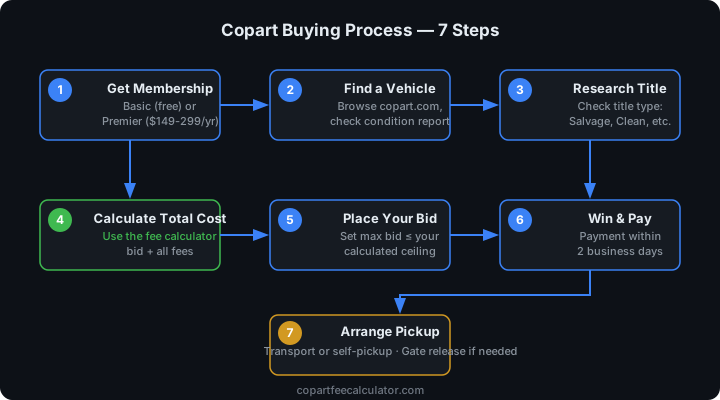
Use the Copart total cost calculator to run these numbers for any bid amount before you place a single bid. It takes 30 seconds and prevents a lot of post-win regret.
Step 5: Place Your Bid Strategically
Copart auctions run as timed online events. Vehicles go live on specific sale days, and you can pre-bid (set a maximum) or bid live during the auction window.
Set a maximum bid, not a target bid. Before the auction opens, calculate your all-in cost at your maximum acceptable total. Work backward: if you can spend $5,000 total on the car before repairs, and fees plus transport will be around $700, your max winning bid is $4,300. That's your ceiling. Don't bid past it.
Pre-bidding vs. live bidding. Pre-bidding lets you enter a maximum amount and Copart's system bids incrementally on your behalf up to that amount. Live bidding is more stressful and more prone to the "just one more increment" trap. Pre-bid with a firm ceiling.
Watch the auction for similar lots first. Before you bid on your target vehicle, watch a few similar vehicles sell. You'll get a feel for where real market prices are landing that day. Overpaying is easy when you're emotionally invested in a specific car.
Account for the "pure sale" vs. "minimum bid" distinction. Some Copart lots are marked "pure sale", meaning the highest bid wins, no reserve. Others have a minimum bid set by the seller. Pure sales can sometimes be won at surprisingly low prices; minimum bid lots won't close below the threshold.
Step 6: Winning and What Happens Next
When you win, Copart sends an invoice to your account. Payment is due within 24-48 hours (confirm the exact window in your account terms). Accepted payment methods include wire transfer, ACH, and certain credit cards, though credit card payments may incur an additional processing fee.
Pay promptly. Late payment can trigger additional charges and eventually account suspension.
After payment clears, Copart releases a gate pass (sometimes called a "member release" or "vehicle release"). You'll need this, along with photo ID, for the vehicle to be released at the yard.
Your storage clock is running from day two of the auction close, regardless of when you pay. Don't wait to pay assuming it buys you time, it doesn't.
Step 7: Arranging Pickup and Transport
You have two options: pick up yourself or use a transport service.
Self-pickup is the fastest and cheapest option if the yard is within driving distance and you have a way to move the vehicle, trailer, flatbed tow truck, or a dolly setup. You avoid transport costs and storage delays entirely.
Hired transport is necessary for most buyers when the yard is in another state or the vehicle isn't drivable. Use established carriers: Montway Auto Transport, uShip, and Stateway Auto Transport all move Copart vehicles regularly. Get quotes before you bid so you know your transport cost in advance.
Book transport before the auction, not after you win. Transport capacity can be tight in certain corridors, and a 7-day delay while waiting for a carrier adds $90-$105 in storage fees on a standard vehicle.
Bring your gate pass and photo ID to the yard. Copart yards have specific release hours, typically weekday business hours with limited Saturday access. Confirm the yard's hours before scheduling your carrier.
Step 8: Common Beginner Mistakes to Skip
A few mistakes show up again and again with first-time buyers. Skip these and you'll have a much smoother experience.
Bidding without calculating total cost first. The winning bid is the starting point, not the ending point. Run the full math on every vehicle before placing a bid. The Copart bid cost estimator makes this fast.
Not researching repair costs before bidding. You don't know your true investment in a vehicle until you know what repairs will cost. Skipping this step is how buyers end up underwater on a rebuild.
Buying a Certificate of Destruction thinking it can be registered. COD vehicles cannot be re-titled in most states. Always check the title type before bidding.
Letting storage fees accumulate. Arrange transport before the auction. A 10-day delay can add $135 in avoidable storage charges.
Winning without a payment plan ready. Copart requires payment within 24-48 hours. Have your payment method set up and funded before the auction, not after.
Ignoring the pickup yard's location. A great deal in a distant state can become a mediocre deal once you factor in transport costs. Always include transport in your budget.
For a deeper look at what trips up experienced buyers too, see the full breakdown in Copart Mistakes Buyers Make.
Starting Right Makes Every Subsequent Purchase Easier
Your first Copart buy sets the pattern for everything that follows. Get the process right, membership, research, full cost calculation, transport planning, and each purchase after that runs faster and more profitably.
The single biggest habit to build is running every potential bid through a total cost calculation before the auction opens. Buyers who do this consistently don't get surprised by invoices. Buyers who skip it frequently do.
For a full breakdown of every fee you'll encounter at Copart, read Copart buyer fees explained in detail, and use the step-by-step Copart fee calculator to build your budget before the auction opens.