The most expensive Copart mistakes aren't dramatic blunders, they're small oversights that compound. Forgetting the virtual bid fee, letting storage rack up, or bidding on a non-repairable title can cost hundreds to thousands more than expected. Every one of these is avoidable with a few minutes of prep.
Copart auctions move fast and the fee structure has enough layers that even experienced buyers slip up. These seven mistakes show up repeatedly, and each one has a straightforward fix.
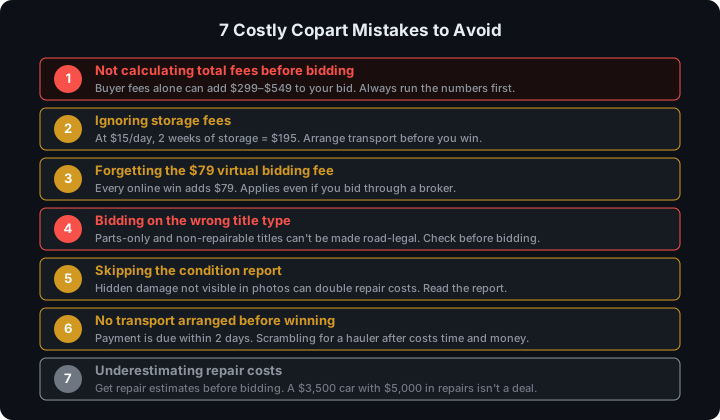
Mistake 1: Bidding Without Calculating Total Fees First
The winning bid is not your cost. It's a starting number.
On top of the bid, a Basic member pays a tiered buyer fee ($299 on a $3,500 bid), a $79 virtual bidding fee if buying online, a $79 gate release fee at pickup, and storage if the vehicle sits more than one day. On that same $3,500 bid with a 3-day pickup, total fees come to $487. The car that looked like a $3,500 deal costs $3,987 before transport.
The fix is simple: before placing a bid, run it through the Copart fee calculator to get the itemized total. Takes 30 seconds. Do it every time.
Buyers who skip this step consistently overbid, because they're mentally budgeting against the bid price alone. Set your max bid after you know the total cost, not before.
Mistake 2: Ignoring Storage Fees
Storage fees are quiet and predictable, which makes them easy to ignore until they're not.
Copart gives you one free day. From day two onward, standard passenger vehicles accrue roughly $15/day. A 10-day delay adds $135 to your invoice. Large vehicles, pickup trucks, vans, SUVs, can run $25-$40/day, making a 10-day hold $250-$400.
The mistake isn't knowing the fee exists, it's winning a vehicle without having transport already arranged. If you win on a Tuesday and your transporter can't pick up until the following Monday, you've bought yourself six days of storage ($90 at $15/day for a standard car).
Book your transporter before the auction, not after. Get a quote and a tentative pickup date from a flatbed service before you set your max bid. If transport won't be available for a week, factor that storage cost into your ceiling.
For a deeper look at how storage fees accumulate and which vehicle categories get hit hardest, the Copart storage fees guide breaks it down by vehicle type and scenario.
Mistake 3: Forgetting the Virtual Bidding Fee
The $79 virtual bidding fee is flat and applies to every online win, regardless of membership level. Premier members don't get a discount on it.
On a $500 vehicle, $79 is a 15.8% surcharge. On a $10,000 vehicle, it's less than 1%. The fee matters most on low-priced lots, and that's exactly where new buyers tend to start, thinking a $400 parts car is a low-risk entry point.
Bid $400. Pay $99 buyer fee (Basic member). Pay $79 virtual bid. Pay $79 gate release. That's $657 before transport on a $400 win, a 64% markup.
In-person bidding avoids the virtual bid fee, but it's logistically impractical for most buyers. If you're bidding on low-value lots, either factor the $79 into your ceiling bid or decide the vehicle isn't worth it at that total cost.
Mistake 4: Bidding on the Wrong Title Type
Copart lists vehicles under several title types: Clean, Salvage, Rebuilt, Non-Repairable (also called Certificate of Destruction or Parts Only), and others depending on the state.
A Non-Repairable or Certificate of Destruction vehicle legally cannot be retitled and driven on public roads. It can only be used for parts or scrap. Buyers who don't catch this before bidding end up with a vehicle they can't register, which makes it worth far less than they paid.
Salvage titles can typically be rebuilt and retitled after passing a state inspection. Clean titles are straightforward. Rebuilt titles mean the vehicle was previously salvage and has already gone through the inspection process.
Check the title type on every listing before you bid. It's listed clearly in the vehicle details. If you're buying for road use, verify you're looking at a salvage or clean title, not a certificate of destruction.
Mistake 5: Skipping the Condition Report
Copart provides a condition report on most vehicles. It lists primary and secondary damage, odometer reading, keys present or absent, and run/drive status. Skipping it is a fast path to an expensive surprise.
"Run and drive" means the car started and moved under its own power at the lot. It does not mean the transmission shifts correctly, the brakes stop the car safely, or the cooling system holds pressure. "Stationary" means it didn't run, but that doesn't mean the engine is seized; sometimes the battery is just dead.
The condition report won't catch everything. Water stains on the B-pillar, bent frame rails, and corroded wiring harnesses don't always show in photos. But skipping the report entirely means you're missing the information that is available.
Cross-reference the VIN with an AutoCheck or Carfax report. Insurance history often shows prior claims that predate the current damage, a vehicle that's been through two total loss events is a very different proposition than one experiencing its first.
Mistake 6: Not Having Transport Arranged Before Winning
This one connects to the storage mistake, but it's worth treating separately. Not having a transporter lined up before the auction is a systems failure, not just a budget error.
Copart payment is due within 3 business days of winning. Once you've paid, the clock on storage starts ticking. If you haven't already reached out to a transport broker or flatbed service, you're scrambling while fees accumulate.
UShip, Montway, and direct flatbed services all accept Copart pickups. Get a quote before the auction, confirm availability for your target pickup window, and have the contact information ready. The gate release process, including the $79 fee, is initiated by you or your transporter, not Copart. Your transporter needs to know this and factor it into their process.
If you're picking the vehicle up yourself, confirm your tow vehicle capacity and the Copart yard hours before the auction date. Hours vary by location, and some yards require appointments for pickup.
Mistake 7: Underestimating Repair Costs
Salvage vehicle repair estimates from photos are almost always optimistic.
A front-end collision that looks like a bumper and hood job in the listing photos can reveal a bent radiator support, a cracked headlight bracket, and a slightly torqued subframe when it's on the lift. What looked like a $2,500 fix becomes $5,500.
Airbag deployment is a common budget-breaker. Replacing a single airbag module, the clockspring, and the seat belt pretensioner can run $1,500-$3,000 depending on the vehicle make. Multiple airbags compound quickly.
Before bidding on any salvage vehicle you plan to repair, do three things:
1. Identify every component visible in the photos as damaged or potentially damaged
2. Look up used OEM part prices for each item (LKQ, car-part.com, or your local pull-a-part)
3. Call a body shop or mechanic with the photos and ask for a rough estimate range
That last step costs nothing and catches most of the surprises. Shops will often give a ballpark over the phone, they'd rather see the job at an honest price than chase a low estimate.
For a realistic breakdown of repair costs by damage type, the salvage title rebuild cost guide walks through collision, flood, hail, and mechanical categories with actual dollar ranges.
Wrapping Up
None of these mistakes require special expertise to avoid. They all come down to one habit: doing the math and the homework before the auction opens, not after.
Start every evaluation by knowing your total acquisition cost. Use the Copart auction total cost tool to calculate buyer fees, virtual bidding, gate release, and storage before you set your max bid. Then layer in your transport quote and repair estimate.
Want to understand how this site and its tools work? Visit our about page for background on the team and methodology.
If you're new to the process, the beginner's guide to buying a salvage car at Copart covers everything from registration to pickup in sequence.