Copart charges a flat $79 virtual bidding fee on every online auction win. It stacks on top of the buyer fee, gate release fee ($79), and any storage. For a $3,000 winning bid as a Basic member, you're looking at $299 (buyer fee) + $79 (virtual bid) + $79 (gate release) = $457 in fees alone, before transport.
What Is Copart Virtual Bidding?
Copart runs live auctions at its 200+ locations across the U.S. Historically, you had to show up in person. Virtual bidding, marketed under their VB3 platform, lets you bid on those same live lanes from anywhere with an internet connection.
You log in, watch a real-time video feed of the lane, and place bids against other online and in-person bidders. The system is competitive and moves fast. Most lots sell in under 60 seconds once the bidding opens.
This model is especially useful if you're targeting vehicles at a yard that's far from you, or if you want to monitor multiple lanes at once without physically being there.
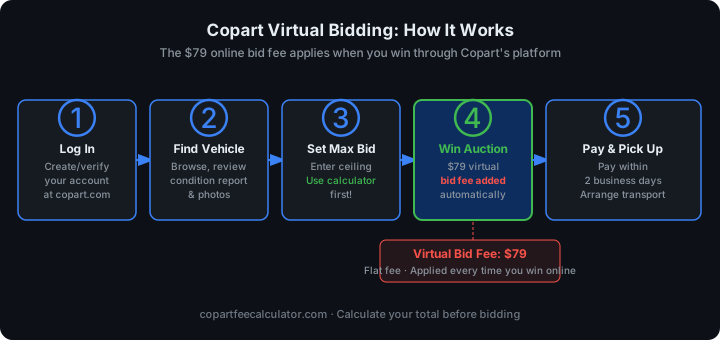
The $79 Virtual Bidding Fee: What It Covers
Copart charges $79 every time you win a vehicle through the virtual bidding platform. This isn't a membership fee, it applies per transaction.
The fee covers the technology infrastructure: live video streaming, server costs, and real-time bid processing. It doesn't give you any extra buyer privileges, and it doesn't reduce the buyer fee.
Here's what that looks like in a real example. Say you win a 2019 Honda Civic at $3,500 as a Basic member:
- Buyer fee (tier: $2,000-$3,999): $299
- Virtual bidding fee: $79
- Gate release fee: $79
- Storage (if picked up same day or next): $0-$15
- Total fees: $457-$472
Your actual cost to own the car before transport and repairs is roughly $3,957-$3,972. Use the Copart fee breakdown tool to run these numbers for any bid amount before you commit.
Premier members still pay the $79 virtual bidding fee, it's not discounted at the membership level, unlike buyer fees. That's worth knowing if you're deciding whether to upgrade.
How to Bid Online at Copart: The Process
Getting set up for virtual bidding takes a few steps:
1. Create a Copart account: Basic membership is free, but Premier membership (~$149-$299/year) cuts buyer fees by roughly 40%.
2. Verify your identity and provide a deposit: Copart requires a refundable deposit (typically $400) before you can bid. This holds against any winning bids.
3. Search for vehicles: Filter by location, make, model, damage type, or auction date.
4. Watch the auction schedule: Live lanes run on set days per location. You'll see the scheduled start time for each lane.
5. Join the lane when it goes live: The video feed opens a few minutes before bidding starts.
6. Bid in real time: You can set a max bid (auto-bid) or bid manually. In-person and other online bidders compete simultaneously.
7. Pay within the deadline: Copart typically requires full payment within 3 business days of winning.
The platform works on desktop browsers and mobile. Latency can be an issue on slow connections, if your bid registers half a second late in a close auction, you may lose the lot.
Virtual Bidding Risks You Should Know
Buying online at salvage auctions isn't the same as buying in person, and the risks compound.
You can't inspect the vehicle yourself. You're relying entirely on Copart's condition report, photos, and the live video during the auction. The condition report lists primary and secondary damage, odometer, keys present, and run/drive status, but it doesn't catch everything.
The video feed during the auction is brief. You might get 20-30 seconds of footage while the car moves through the lane. That's not enough to spot a bent frame, flood staining on the carpet, or a seized engine.
Run/drive status isn't a guarantee. "Runs and drives" means the engine started and the car moved under its own power at the lot. It doesn't mean the transmission shifts cleanly or the brakes are safe.
Hidden damage is common. NAAA (National Auto Auction Association) guidelines define condition grades, but Copart uses its own system. Cross-referencing the VIN with an insurance history report through services like AutoCheck or Carfax can reveal prior claims that Copart's report doesn't show.
These aren't reasons to avoid virtual bidding, they're reasons to price risk into every bid. Avoid the common trap of bidding up to market value on a car you've never physically inspected. See the full list of costly errors buyers make at Copart auctions before you bid.
Virtual vs. In-Person: Which Is Better?
Neither is strictly better. They serve different buyer profiles.
In-person bidding makes sense if:
- You're within driving distance of the yard
- You want to do a quick walkaround before the car enters the lane
- You're buying frequently enough that trips are worthwhile
Virtual bidding makes sense if:
- The best inventory for your budget or target model is at a yard far from you
- You're buying part-time and want flexibility
- You want to monitor multiple lanes simultaneously
The $79 fee is a real cost, but it's often worth it when it opens up access to inventory across the country rather than just one local yard.
One practical note: even if you plan to bid virtually, visiting a Copart yard at least once in person is worth the trip. You'll get a feel for how fast lanes move, what condition grading looks like in real life, and how the post-auction payment and gate release process works.
For a deeper look at how membership type affects your per-vehicle cost, see Basic vs. Premier Copart membership.
Wrapping Up
The $79 virtual bid fee is predictable and flat, unlike buyer fees, which scale with your bid. For lower-priced vehicles, it's a more significant percentage of your total cost. On a $500 win, the virtual bid fee alone is 15.8% on top. On a $10,000 win, it's less than 1%.
Before every auction, run your numbers. The Copart auction cost estimator handles all the tiers, buyer fees, virtual bid, gate release, and storage, so you know exactly what you're walking into.
Want to understand how this site works and who builds these tools? Visit the about page for background on the team.