Copart and IAAI (Insurance Auto Auctions) use similar tiered fee structures, but their exact rates differ by tier and membership level. On a $3,500 vehicle, total fees at both platforms land within $30-$50 of each other for comparable membership tiers. Vehicle selection and yard proximity often matter more than the fee gap.
The two biggest salvage auction platforms in North America, Copart and IAAI (now rebranded as IAA, owned by RB Global), compete directly for the same inventory. Buyers who only use one platform are likely leaving money on the table, but not necessarily because of fees. Here's how the numbers actually compare.
How Copart and IAAI Fee Structures Differ
Both platforms charge buyers a transaction fee layered on top of the winning bid. Both use tiered pricing where the fee is a flat dollar amount at lower bid levels and shifts to a percentage at higher bid amounts. Both charge additional fees for online bidding and vehicle release.
The differences are in the specific amounts at each tier, the membership tiers available, and a few platform-specific add-ons.
Copart calls its premium tier "Premier membership" and charges roughly $149-$299/year. Premier members pay approximately 40% less in buyer fees vs. Basic members across every tier.
IAAI calls its membership tiers differently, buyers register as Basic members and can upgrade to a "Premier" or equivalent account. IAAI's fee structure is also tiered but structured slightly differently, and IAAI has historically charged environmental/service fees that Copart doesn't always add.
One key difference: IAAI has moved more aggressively toward online-only bidding infrastructure since RB Global's acquisition. Copart still operates physical auction lanes at many locations alongside its online platform.
The National Auto Auction Association (NAAA) provides industry guidelines that both platforms nominally follow for fee disclosure, but neither is required to match the other's rates. For details on how the fee data on this site is sourced and verified, see the About page.
Copart Fee Breakdown
Copart's Basic member buyer fees in 2025 run from $59 (bids under $100) up to 3.5% of the bid price (bids over $50,000). The most active range for individual buyers, $1,000 to $10,000, sees flat fees between $199 and $549.
Additional charges on top of the buyer fee:
- Virtual bid fee: $79 (online bidding)
- Gate release fee: $79 (every pickup)
- Storage: Free day one, ~$15/day from day two
For the full Copart fee table and a calculation tool, see Copart Buyer Fees Explained: Complete 2025 Breakdown or run your numbers through the Copart fee calculator directly.
IAAI Fee Breakdown
IAAI's fee structure is similar in shape but differs in specific amounts. Based on publicly available data and buyer reports, approximate IAAI buyer fees for standard (non-dealer) accounts:
| Bid Amount | IAAI Approx. Buyer Fee |
|---|---|
| Under $100 | ~$69 |
| $100 - $499 | ~$99 |
| $500 - $999 | ~$149 |
| $1,000 - $1,999 | ~$209 |
| $2,000 - $3,999 | ~$309 |
| $4,000 - $5,999 | ~$359 |
| $6,000 - $7,999 | ~$409 |
| $8,000 - $9,999 | ~$459 |
| $10,000 - $14,999 | ~$559 |
| $15,000+ | Percentage-based |
IAAI also charges a separate internet bid fee for online bidding, typically around $79-$89 depending on the account type. Environmental fees (sometimes called "document fees") can add $15-$25 per transaction at some locations.
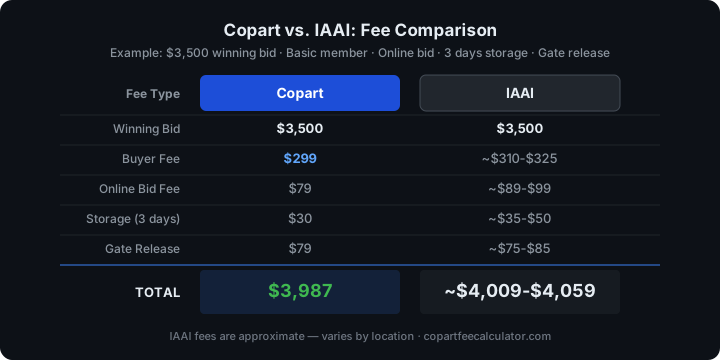
Important caveat: IAAI's fees vary by location, vehicle type, and account level more than Copart's do. Always confirm the exact fees on your IAAI account dashboard before bidding. The figures above are approximations based on publicly available rate data and buyer-reported experiences through mid-2025.
Side-by-Side Comparison on a $3,500 Vehicle
Here's a realistic total-cost comparison for a Basic/standard member winning a $3,500 vehicle at each platform, picking up within 3 days:
| Line Item | Copart (Basic) | IAAI (Standard) |
|---|---|---|
| Winning bid | $3,500 | $3,500 |
| Buyer fee | $299 | ~$309 |
| Online bid fee | $79 | ~$79-$89 |
| Storage (2 days) | $30 | ~$25-$35 |
| Gate/release fee | $79 | ~$79 |
| Environmental fee | $0 | ~$15-$25 |
| Total at platform | ~$3,987 | ~$4,007-$4,037 |
On this scenario, Copart comes out roughly $20-$50 cheaper. That's a real but narrow difference. At higher bid amounts, the gap can widen, particularly if IAAI's environmental or document fees apply and Copart's don't.
For Premier/upgraded members, both platforms discount buyer fees by a comparable percentage. The relative difference between platforms stays roughly the same regardless of tier.
Which Platform Has Better Vehicle Selection?
Fees matter, but inventory is often the deciding factor. Both platforms source primarily from insurance companies, Copart's top sellers include State Farm, Allstate, and GEICO. IAAI sources similarly from major carriers. In practice, both platforms list vehicles from the same insurers, just split across their respective lots.
Volume: Copart is generally considered the larger platform by total vehicle count in the US. They operate 200+ locations nationwide. IAAI operates roughly 170+ locations.
Regional variation: In some markets, one platform dominates. If the only yard within 150 miles is an IAAI lot, that's your platform for anything requiring local pickup or self-transport.
Vehicle categories: Copart tends to have stronger inventory in the southern and western US. IAAI has historically had strength in the midwest and northeast. This is generalizing, check both platforms for your specific region.
Special inventory: Both platforms sell non-title vehicles, whole cars, and specialty/heavy equipment. Copart has a larger boat and heavy equipment presence; IAAI handles more fleet vehicles in some regions.
For first-time buyers especially, it's worth registering on both platforms and watching what comes through in your region for a month before committing significant money. The inventory difference in your specific market may be the real deciding factor.
Which Should You Use? A Practical Answer
For most buyers, the answer is both, eventually. But if you're starting out or choosing a primary platform, here's a straightforward framework:
Use Copart if:
- You're buying a specific vehicle type that Copart has more of in your region
- You prefer Copart's platform and have already established a membership
- You want the most widely used fee calculator tools and community resources (including the Copart fee breakdown tool)
- You're rebuilding for resale and want Premier membership savings on volume buys
Use IAAI if:
- The closest salvage yard in your area is IAAI
- A specific vehicle you want is listed only on IAAI
- You've priced both platforms for the same vehicle type and IAAI is running cheaper in your market
Use both if:
- You're a dealer or rebuilder buying at volume
- You want to compare cross-platform prices before bidding
- You have transport infrastructure that makes multi-platform buying logistically feasible
The fee difference on most transactions is $20-$50 in favor of Copart. That's real money, but it won't determine whether a deal is profitable. The vehicle condition, your repair cost estimate, and your final all-in budget are the variables that matter far more.
Before bidding on either platform, run your all-in numbers. For Copart specifically, use the full cost estimator for Copart auctions to confirm your buyer fee, add-ons, and estimated total before the auction opens. For a deeper look at how to structure your first purchase, the beginner's guide to buying at Copart covers every step from registration through pickup.
The Bottom Line
Copart and IAAI are more similar than different when it comes to fees. Neither has a dramatically cheaper structure, the gap on most transactions is under $50. What actually determines your total cost is the vehicle's condition, your repair budget, transport logistics, and how quickly you pick up.
Register on both platforms. Learn both fee structures. Make your platform choice based on where the right vehicle is, not where the fees are marginally lower.