Hail-damaged vehicles with no mechanical issues are the most reliable Copart buys for resale or personal use. Minor collision damage on Japanese and domestic trucks also tends to work well. Flood vehicles and high-cost luxury makes are the riskiest, the repair scope is hard to pin down and the cost overruns are routine.
Copart lists tens of thousands of vehicles every week. Most of them aren't worth bidding on. A small subset represents real value, but only if you know what you're looking for and you've done the fee math before placing a bid.
What Makes a Copart Vehicle a Good Buy?
Three factors determine whether a Copart vehicle is worth pursuing:
1. The damage is predictable. You can estimate repair costs accurately from photos and the condition report before the auction. Hail dents are countable. A crumpled bumper and hood are visible. A "water/flood" listing with no photos of the interior is not predictable.
2. The fee-adjusted acquisition cost leaves room. Copart fees stack quickly. A vehicle with a $4,500 winning bid as a Basic member costs $349 (buyer fee) + $79 (virtual bid) + $79 (gate release) + transport = roughly $5,200-$5,500 before you've done any work. If the repaired value is $7,500 and repairs cost $2,000, you've got margin. If repairs cost $4,000, you don't.
3. The title type lets you use or sell it. Salvage titles can become rebuilt titles after inspection. Non-repairable or Certificate of Destruction vehicles can only be parted out or scrapped. Know which you're buying before you bid.
Start every evaluation by knowing your acquisition cost precisely. The Copart fee calculator handles buyer fee tiers, virtual bidding, gate release, and storage in one calculation.
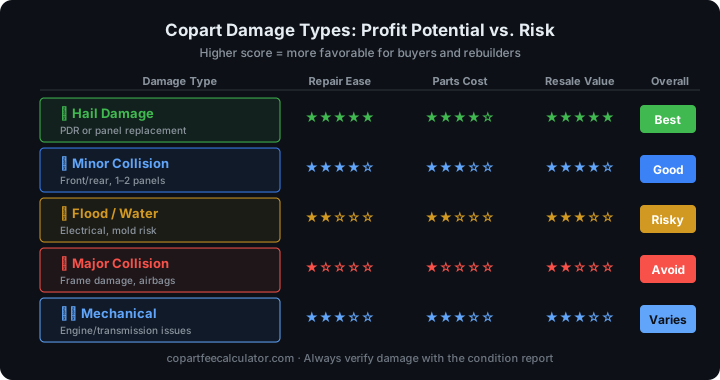
Best Damage Types for Rebuild Profit
Hail Damage: Highest Upside
Hail-damaged vehicles are the closest thing Copart has to a reliable opportunity. The car runs and drives. The drivetrain is untouched. The damage is cosmetic, dents on the roof, hood, trunk lid, and sometimes the pillars.
Paintless dent repair (PDR) technicians charge per dent. A sedan with 80 dents and no broken glass might cost $2,200-$3,000 to restore. A heavier hail hit with 200+ dents and a broken windshield might run $5,000-$7,500.
The advantage: you can count the dents in the listing photos and get PDR quotes by phone before the auction. It's one of the few damage types where the repair scope is genuinely visible upfront.
The downside: everyone knows this. Hail lots attract competitive bidding, and prices on desirable models can push close to market value. Run the numbers, if the bid plus fees plus PDR cost approaches the clean-title market value, the deal isn't there.
Minor Collision Damage: Good When Scoped Correctly
Front or rear collision with no airbag deployment, no frame damage, and no structural compromise can be repaired for $2,000-$5,000 on most vehicles. The key qualifiers are:
- No airbag deployment (airbag replacement adds $1,500-$4,000)
- No frame/unibody damage visible in the photos
- Damage contained to bolt-on parts (bumper covers, fenders, hood, headlights)
Condition reports list airbag status. If the condition report says airbags deployed, budget accordingly, or look elsewhere.
Flood Damage: High Risk, Sometimes Worth It
Flood vehicles can work in specific circumstances: minor flood with interior-only exposure, no electrical symptoms, and a low enough bid to absorb uncertainty.
Most flood vehicles don't meet those conditions. Water that reaches the ECU, BCM, or wiring harnesses creates issues that take months to surface, corrosion inside connectors causes intermittent faults that aren't visible at purchase. Insurance Auto Auctions (IAAI) and Copart both classify flood depth differently, and neither guarantees the full exposure is documented.
If you're drawn to a flood vehicle, the bid needs to be low enough that you can absorb a $5,000-$10,000 surprise on top of your repair estimate. Most buyers aren't in that position.
Vehicle Categories That Hold Value Well
Mid-size Japanese sedans and crossovers: Toyota Camry, Honda Accord, Honda CR-V, Toyota RAV4. Parts are cheap and widely available. Mechanics know these platforms. Rebuilt-title demand from budget buyers is consistent. These vehicles hold value well even with a rebuilt title because buyers trust the mechanicals.
Domestic full-size trucks: F-150, Silverado, Ram 1500. Trucks hold resale value better than most categories with rebuilt titles, partly because truck buyers are more likely to care about utility than title history. Parts (beds, bumpers, fenders) are available used in abundance.
Compact and mid-size SUVs in the $3,000-$8,000 bid range: The fee structure still leaves margin at these price points. Buyer fees for a $6,000 win are $399 for a Basic member, so total acquisition runs around $6,600-$7,100 after fees and transport. If the vehicle repairs to $12,000-$14,000 in value, there's real room.
Models to Avoid (by Category, Not Name)
High-cost-to-repair luxury vehicles. European luxury makes, regardless of which brand, have parts costs 2-4x what comparable Japanese or domestic vehicles cost. A BMW front clip that would cost $2,500 on a Camry can cost $6,000-$9,000 in OEM parts. Add dealer-level labor rates for specialist shops and the repair math rarely works.
Older high-mileage vehicles in the $500-$1,500 bid range. These look cheap but they're often money pits. A 12-year-old sedan with 140,000 miles and collision damage may need $3,000 in repairs just to be road-legal, and its clean-title value at that mileage might be $4,000. The margin is paper thin and the unknowns multiply with age.
Any vehicle with an unknown or unclear title type. If the title type isn't clearly listed as Salvage or Clean, check before bidding. A Certificate of Destruction is worth scrap value, not vehicle value.
How to Verify If a Deal Is Actually a Deal
Before placing a bid, run through this checklist:
1. Check the title type. Salvage or clean only for road use.
2. Read the full condition report. Note primary damage, secondary damage, airbag status, run/drive status, and odometer.
3. Pull the VIN history. AutoCheck or Carfax, look for prior total loss claims before this event.
4. Estimate repair costs. Look up used OEM parts prices, get a ballpark from a shop.
5. Calculate total acquisition cost. Bid + buyer fee + virtual bid fee + gate release + storage estimate + transport.
6. Look up the rebuilt-title value. Search completed listings on AutoTrader and Facebook Marketplace for rebuilt-title versions of the same model and year.
7. Check the spread. (Rebuilt value) minus (acquisition cost + repair cost) is your rough margin. If it's under $1,500, walk away.
A Real Example: Evaluating a $4,500 Winning Bid
A 2019 Chevrolet Silverado 1500 with hail damage, run and drive, no airbag deployment, 52,000 miles. Winning bid: $4,500. Basic member, virtual bidding.
Acquisition cost:
| Item | Amount |
|---|---|
| Winning bid | $4,500 |
| Buyer fee ($4,000-$5,999 tier) | $349 |
| Virtual bid fee | $79 |
| Gate release fee | $79 |
| Storage (1 day free, pickup day 2) | $15 |
| Transport (200 miles, flatbed) | $400 |
| Total acquisition | $5,422 |
Repair estimate:
Hail damage, 150 dents across the roof, hood, cab, and bed rails. Two cracked tail light lenses. No glass breakage.
PDR quote (roof + hood + cab): $3,200. Tail lights (used OEM): $180. Total repair: $3,380.
All-in cost: $8,802.
A clean-title 2019 Silverado 1500 with 52,000 miles in average condition runs $22,000-$25,000. A rebuilt-title example in the same condition range typically sells for $17,000-$19,000.
Margin at $17,000 exit: $8,198. That's a legitimate deal, provided the PDR quote holds and there are no hidden surprises under the truck bed liner.
Use the Copart bid cost estimator to run fee calculations for your own scenarios before bidding.
Wrapping Up
The best Copart buys aren't rare. They're just the ones where you've done the work before the auction instead of after. Know the damage type, know the repair cost, know the fee stack, and know the exit value.
Hail vehicles and minor-collision trucks in the $3,000-$8,000 range consistently offer the most predictable path to positive outcomes. Flood vehicles and high-repair-cost luxury makes don't, at least not without deep expertise in those specific platforms.
For a realistic breakdown of what rebuilding a salvage car actually costs once you've won, read the salvage title rebuild cost guide. And to understand the mistakes that derail even experienced buyers, the common Copart buyer mistakes guide covers the full list.
Want to know more about the team behind these tools? The about page has the details.