A salvage car that costs $4,500 at auction often runs $8,000-$14,000 all-in after Copart fees, transport, parts, labor, and inspection. The math can still work, but only if you account for every cost layer before you bid, not after.
What Is a Salvage Title Vehicle?
A salvage title means an insurance company declared the vehicle a total loss, typically when repair costs exceeded 75-80% of its pre-damage market value (the threshold varies by state). The car isn't necessarily destroyed. It might have significant collision damage, flood exposure, hail damage, or a mechanical failure the insurer didn't want to pay to fix.
Once a car is totaled, the insurer takes ownership and typically sells it through salvage auctions like Copart or IAAI (Insurance Auto Auctions). Buyers who purchase the vehicle and repair it to roadworthy condition can apply for a rebuilt title in their state.
The rebuilt title sticks with the car permanently. It affects resale value and insurance options for the life of the vehicle. That's a real trade-off, and any rebuild budget needs to account for the lower exit value.
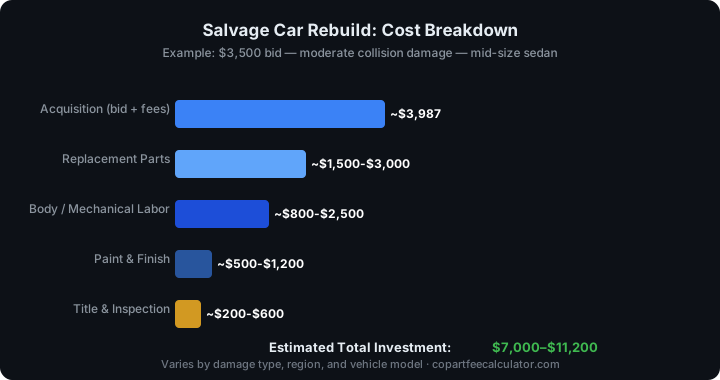
The True Acquisition Cost From Copart
The auction bid price is just one number. Before you budget for repairs, you need to know your actual cost to get the car in your driveway.
Take a concrete example: a 2020 Toyota Camry with front-end collision damage, listed at a Copart yard 150 miles away. You win it at $5,200 as a Basic member.
Here's what you actually pay:
| Cost Item | Amount |
|---|---|
| Winning bid | $5,200 |
| Buyer fee (tier: $4,000-$5,999) | $349 |
| Virtual bidding fee | $79 |
| Gate release fee | $79 |
| Storage (2 days) | $30 |
| Transport (150 miles, flatbed) | $350 |
| Total acquisition cost | $6,087 |
That's $887 in fees and transport before you've touched a wrench. Run your own bid through the Copart total cost calculator to see how these tiers stack for your specific situation.
If you'd won the same car at $6,000 instead of $5,200, the buyer fee jumps to the $6,000-$7,999 tier at $399, an extra $50 on top of the higher bid. Fee tiers matter most near the boundaries.
Typical Repair Costs by Damage Type
Repair costs depend heavily on what caused the total loss. Here's what each damage type typically costs to fix properly.
Collision Damage
Front or rear collision is the most common salvage category. Costs vary based on how far the impact traveled into the vehicle.
- Cosmetic collision (bumper, hood, fenders, no airbag deployment): $2,500-$5,000 in parts and labor
- Moderate collision (radiator support damage, airbag deployment, hood buckled): $5,000-$10,000
- Severe collision (frame/unibody damage, engine cradle impact): $10,000-$20,000+ and often not worth pursuing
Airbag replacement alone can cost $2,000-$4,000 depending on how many deployed and the vehicle make. OEM airbags are expensive; aftermarket units are cheaper but not always certifiable for rebuilt title inspection.
Flood Damage
Flood vehicles are the highest-risk category. Water damage to electronics, wiring harnesses, and interior components is notoriously hard to scope accurately.
- Minor flood (interior only, no electrical symptoms): $3,000-$7,000
- Moderate flood (ECU or BCM exposure, some harness damage): $6,000-$15,000
- Deep flood (engine hydrolocked, full electrical failure): $10,000-$25,000+ and often not viable
Insurance Auto Auctions (IAAI) and Copart both list flood vehicles as "Water/Flood" in the primary damage field. Check odometer consistency, a waterlogged cluster can freeze at a falsely low reading.
Hail Damage
Hail is a favorite among resellers because the damage is typically cosmetic. The car runs fine; it just looks battered.
- Light hail (50-100 dents, no broken glass): $1,500-$3,500 via paintless dent repair (PDR)
- Heavy hail (200+ dents, broken windshield/sunroof, damaged roof panels): $4,000-$9,000
PDR technicians charge per dent in most markets. A sedan with 80 dents might run $2,200-$2,800 at a reputable shop. Roofs with extensive damage sometimes require panel replacement instead of PDR, which is significantly pricier.
Mechanical Failure
"Mechanical" total losses, engine failure, transmission failure, fire damage, are more hit or miss.
- Engine replacement (used): $1,500-$4,500 for most domestic and Japanese makes; $3,000-$8,000+ for European models
- Transmission replacement (used): $1,200-$3,500
- Fire damage: Extremely variable. Wiring fires are especially expensive and rarely worth chasing.
Parts and Labor: What to Budget
Labor costs depend on your market. A body shop in rural Mississippi charges less than one in Los Angeles. Nationally, shop rates run $85-$150/hour for body work and $95-$170/hour for mechanical.
Plan on these rough labor hours for common jobs:
- Front clip replacement (hood, bumper, fenders, radiator support): 20-35 hours
- Airbag clock spring and sensor replacement: 4-8 hours
- Full repaint (roof to rocker): 30-50 hours
- Quarter panel replacement: 12-20 hours
Used OEM parts from pull-a-part yards or LKQ typically run 40-60% of dealer new prices. Aftermarket parts vary wildly in quality, for suspension, airbags, or structural components, used OEM is almost always the better choice.
Rebuilt Title Inspection and Re-Registration Costs
After repairs, most states require a salvage vehicle inspection before issuing a rebuilt title. The process and cost vary:
- Inspection fee: $50-$200 depending on state
- Re-registration: $50-$300 (includes title fee and registration)
- Safety inspection (some states require a licensed mechanic sign-off): $75-$150
- VIN verification: Some states charge $25-$75 for this step separately
California, Florida, and Texas have more involved inspection processes than many other states. California's Bureau of Automotive Repair requires both a safety and smog inspection before a rebuilt title is issued. Build these costs into your budget from day one.
Some states, including New York, don't issue rebuilt titles at all. If you're in one of these states, registering a formerly salvage vehicle becomes complicated or impossible.
Is Rebuilding a Salvage Car Worth It? A Realistic Look
The math works when three conditions are true: the damage is predictable, you can get competitive repair quotes before bidding, and the rebuilt value still gives you meaningful equity.
Here's the Camry example from above, taken all the way through:
| Cost Item | Amount |
|---|---|
| Total acquisition cost | $6,087 |
| Collision repair (moderate, airbags deployed) | $7,500 |
| Rebuilt title inspection and registration | $350 |
| Total all-in cost | $13,937 |
A clean-title 2020 Toyota Camry in average condition trades around $18,000-$20,000. A rebuilt-title example might fetch $13,000-$15,000 depending on condition and local market. That's thin margin, and there's real execution risk, cost overruns happen.
The deals that actually work tend to be hail-damage vehicles with no structural or mechanical issues, or vehicles with very specific minor damage that a shop has already quoted in writing before the auction.
For a guide on which vehicle types tend to work best, see best cars to buy at Copart for profit or personal use. And before you place a single bid, read the beginner's guide to buying a salvage car at Copart, it covers title types, condition reports, and what not to skip.
Wrapping Up
The salvage rebuild path isn't a shortcut. It rewards buyers who do the homework: know the damage type, get repair quotes first, understand the fee stack, and have a realistic exit value in mind.
Start every evaluation by knowing your acquisition cost precisely. The Copart fee estimator calculates buyer fees, virtual bidding, gate release, and storage in one place, so your repair budget starts from an accurate foundation.